Oura recommends the index finger as the default choice, with the middle finger as a solid second option. Which finger you choose affects more than comfort — it changes how consistently the ring reads your heart rate, temperature, and movement. Here’s why finger choice matters and how to pick the right one for you.(If you haven’t determined your size yet, see our Oura Ring size guide or view the full Oura Ring size chart for conversions).
The Short Answer: Index or Middle Finger
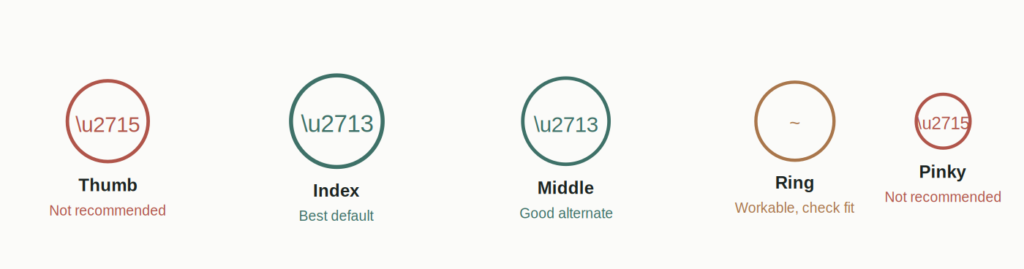
For most people, the index or middle finger on either hand gives the most consistent sensor readings. Both sit close to the base of the hand with relatively stable blood flow and don’t flex as dramatically during everyday tasks as the thumb or pinky do. If you’re not sure where to start, finding the best finger for Oura Ring placement usually leads to the index finger as the safer default – it’s also what Oura’s own sizing kit and marketing default to, so you’ll find the most sizing reference material built around it.
Why Finger Choice Affects Sensor Accuracy
Oura’s sensors read blood flow and temperature through the skin, and both signals are cleaner when the finger stays relatively still and maintains steady contact. Fingers that move constantly — gripping, typing, gesturing — introduce more motion artifacts into the reading, the same way a fitness tracker on a wrist that swings a lot during a run picks up more noise than one that’s relatively stationary.
The thumb and pinky tend to see more incidental movement and pressure throughout a normal day — the thumb from gripping and pinching, the pinky from bracing against surfaces — which is part of why they’re not the first recommendation, even when they happen to be the correctly-sized finger.
Can You Wear It On Your Ring Finger?
Workable, with two things to check first. If you already wear a wedding band or other ring on that finger, consider whether you’re comfortable wearing two rings stacked on the same finger some people find it uncomfortable or visually cluttered, others don’t mind at all. Second, remember that your “usual” ring size on that finger may not directly translate to your Oura size, for the same reasons covered in our guide on why Oura sizing is different from normal ring sizing.
If the ring finger is your only comfortable option — due to an old injury on other fingers, for example — it’s a completely reasonable choice. Accuracy differences between fingers are real but modest for most people; comfort and consistency of wear matter more than chasing a theoretically optimal finger you won’t actually wear the ring on.
What About the Thumb or Pinky?
Both are possible but not the first recommendation. The thumb moves more than any other finger during normal hand use, which can introduce more noise into movement and heart-rate data. The pinky is usually the smallest finger, which can make finding a secure, comfortable fit harder, and it also sees frequent incidental pressure from gripping and bracing.
If you’ve tried index and middle and neither is comfortable — due to sizing, an old injury, or personal preference — thumb or pinky can still work. Expect somewhat more variability in your data than you’d get from the two default fingers, and don’t be surprised if the ring feels slightly less secure over time on the pinky specifically, since it has the least surface area to hold the ring in place.
Dominant Hand vs Non-Dominant Hand
Your non-dominant hand generally sees less incidental impact and movement throughout the day — fewer knocks, less gripping, less exposure to friction from tools, keyboards, and everyday tasks. That makes it a slightly gentler environment for the ring itself, though it’s a minor factor compared to finger choice.
Neither hand is objectively “more accurate” for sensor purposes; this is more about day-to-day comfort and reducing wear on the ring than about data quality.
What If Your Preferred Finger Doesn’t Fit Well?
Choose your size first, then decide on the finger—not the other way around. Use the Oura Ring size guide calculator on the finger you plan to wear the ring on. If that finger doesn’t match one of Oura’s available whole sizes, don’t force an incorrect fit just to keep wearing it there. Instead, it’s better to switch to your second-choice finger than wear a ring that’s too loose or too tight.
A practical approach is to start with your preferred finger—usually the index or middle finger if it’s comfortable. Measure that specific finger using the Oura Ring size chart, check the recommended size against the sizes available for your Oura Ring generation, and then decide whether that finger provides the right fit. If it doesn’t, repeat the process with your backup finger to find the most accurate and comfortable option.
Frequently Asked Questions
Can I wear my Oura Ring on any finger?
Yes, technically, but Oura recommends the index or middle finger for the most consistent sensor readings. Other fingers will still function, with somewhat more potential for movement-related noise in the data.
Does wearing it on a different finger affect accuracy?
It can, modestly. Fingers that move more during daily activity — the thumb especially — tend to introduce more motion artifacts into heart rate and movement readings than the more stable index or middle finger.
Can I wear it with a wedding ring on the same finger?
Physically yes, if the sizing works for both, but many people prefer to keep the Oura Ring on a separate finger from other jewelry for comfort and to avoid the two rings rubbing against each other.
Does dominant vs non-dominant hand matter for accuracy?
Not significantly for sensor accuracy. It’s more a comfort and wear-and-tear consideration — your non-dominant hand typically experiences less incidental impact throughout the day.
What if my index finger doesn’t fit well?
Try the middle finger next, since it’s Oura’s recommended second choice. Measure it specifically rather than assuming your index finger size carries over — finger sizes vary across the same hand.
This guide is published by Oura Ring Size, an independent sizing resource not affiliated with, endorsed by, or sponsored by Oura Health Oy. “Oura” and “Oura Ring” are trademarks of Oura Health Oy, referenced here only to describe compatibility.